Why the 1600 Series Is Now a Strategic Asset for Regulated Institutions
Think about the last time a customer ignored an OTP call. Or worse if flagged as spam. The problem usually isn't the message. It's the number it came from.
In 2024 alone, India recorded approximately 147 million complaints against spam calls and messages. On average, mobile users receive 3 spam calls per day, a significant proportion originating from entities misusing standard 10-digit numbers. The 1600 series is TRAI's direct response to this crisis.
In regulated industries, the originating number on a transactional call is a trust signal. Banks, insurers, and broking firms that get this wrong don't just lose the call - they erode the credibility of every communication that follows. That's exactly the problem the 1600 number series was designed to solve.
Mandated by TRAI and co-enforced by RBI, IRDAI, SEBI, and PFRDA for transactional and service voice communications, the 1600 series has moved from a compliance footnote to a strategic infrastructure priority. For IT heads in BFSI, the question is no longer whether to implement it, it's whether your current implementation can actually hold up at enterprise scale.
Contents
1. What is the 1600 Series and Why TRAI Mandated It
2. The Technical Foundation: What Your Architecture Needs
3. Fraud Is a Real Threat on Transactional Channels
4. How to Architect the Integration Layer
5. Monitoring and SLAs: Delivery Reliability Is Non-Negotiable
6. Audit Trails and Compliance Reporting
7. Where Most Implementations Go Wrong
8. Your Action List for This Quarter
1. What is the 1600 Series and Why TRAI Mandated It
The 1600 series is a dedicated number range for high-trust, regulated voice communications. TRAI mandates it specifically for:
- Transactional alerts - OTPs, trade confirmations, payment authorisations
- Service notifications - policy renewals, account alerts, billing updates
- Regulatory messaging - statutory notices and compliance-driven financial alerts
What makes it different from a regular outbound number? Recognition. Telecom networks and customers have been conditioned to treat 1600 numbers as verified and credible. That recognition alone drives better call answer rates and reduces abandonment, particularly on OTP and confirmation calls where timing is critical.
The 1600 series is TRAI's answer to a growing trust deficit in enterprise voice communications. TRAI ultimately determined that mandatory, time-bound migration was the only way to close the gap and create a sector-wide trusted calling framework.
2. The Technical Foundation: What Your Architecture Needs
Build an origination framework that doesn't rely on humans
Your core banking, policy management, or trading system needs to reach your telecom provider without manual intervention. The moment a human step enters the call dispatch chain, you've introduced latency, error risk, and an audit gap.
What the architecture must include:
- API-driven call dispatch is fully automated, using pre-registered and templated voice scripts
- End-to-end encryption has mutual TLS, secure token authentication, encrypted payloads
- Immutable call records for every trigger logged with timestamp, template ID, and outcome
This is not about elegance. It's about producing a system that regulators can audit and that operations teams can defend.
Choose the right connectivity option for your infrastructure
The 1600 series can be provisioned via three connectivity modes and the right choice depends on your site infrastructure:
- SIP Trunk is recommended for enterprises with existing IP-based telephony infrastructure
- PRI (Primary Rate Interface) is suitable for organisations running legacy TDM-based telephony environments
- Internet Telephony is used where site feasibility rules out SIP Trunk or PRI
Discuss site feasibility with your telecom provider early. Connectivity choice affects provisioning timelines which is a factor that matters given the tight compliance calendar.
Make DLT template registration part of your release process
Every voice script in a transactional flow must be pre-registered on the DLT (Distributed Ledger Technology) platform with a valid template ID before it goes live. This is a regulatory requirement, not a suggestion.
The practical problem: templates change. New products launch, regulations shift, scripts get updated. If template registration is a manual step handled outside the release cycle, it will fall behind and non-compliant calls will get rejected at the telecom layer.
The fix is straightforward: integrate DLT template submission into your pipeline. New scripts get submitted automatically as part of the deployment process. Template IDs sync back to your systems without human intervention.
Never let marketing and transactional calls share the same path
This is one of the most common and most damaging implementation mistakes in BFSI. When a customer starts receiving promotional calls from the same number that sends their OTPs, trust collapses and it's very difficult to rebuild.
The routing segregation must be enforced at the system level:
- Marketing and promotional voice: 140 series or other designated non-transactional numbers
- Transactional and service voice: 1600 series, exclusively
A policy document is not sufficient here. This boundary must be built into your routing logic so it cannot be bypassed intentionally or otherwise.

3. Fraud Is a Real Threat on Transactional Channels
Transactional voice channels are high-value fraud targets for a simple reason: customers trust them. A compromised OTP channel at a bank or broking firm isn't a technical incident. It's a reputational crisis.
This is precisely why TRAI moved beyond voluntary adoption. With fraudsters increasingly impersonating BFSI entities using standard 10-digit numbers, customers had effectively lost the ability to distinguish legitimate service calls from scam calls. The 1600 series creates a clear, system-enforced boundary. Once customers internalise that genuine banking and insurance calls come only from 1600 numbers, the fraudulent imitation becomes far harder to execute.
The security controls that must be in place:
- Caller ID validation at every dispatch 1600 series presence verified before the call leaves your system
- SIEM integration - real-time tracking and alerting on suspicious call trigger patterns
- Behavioural anomaly detection - automated flags for high-frequency OTP requests, unusual geographic clustering, or off-hours call spikes
Fraud prevention on transactional voice isn't just an IT concern. It's a board-level risk with direct impact on customer trust and regulatory standing.
4. How to Architect the Integration Layer
A clean integration follows a layered model where each component has a single, well-defined responsibility:
Application Stack → Secure API Layer → Telecom Provider APIs → Network → Customer
- Application layer: owns business logic - what to send, when to send it, and under what conditions
- Secure API layer: handles authentication, payload formatting, rate governance, and retry logic
- Telecom API layer: manages actual call delivery using DLT validated templates
The reason this separation matters: individual layers can be upgraded without breaking the others. When TRAI updates DLT requirements (and it will), you change the telecom API layer and not your core banking system. That kind of modularity is what makes the architecture sustainable.
5. Monitoring and SLAs: Delivery Reliability Is Non-Negotiable
An OTP that arrives 90 seconds late during a time-sensitive transaction is not a minor inconvenience. It's a failed customer interaction and, depending on the context, a potential compliance event.
For IT heads in regulated sectors, delivery reliability has to be measured, not assumed. KPIs to track continuously:
- Call delivery success rate is your primary SLA compliance metric
- Delivery latency and jitter is an early warning indicator for network or provider degradation
- Template rejection rate is a direct signal of DLT compliance health
- Provider SLA adherence - hold your telecom vendor to their commitments with data
Manual reporting cannot keep pace with enterprise call volumes. Insist on real-time dashboards or API-level metrics access from your telecom provider. If they can't offer it, treat that as a procurement red flag and not a minor gap.
6. Audit Trails and Compliance Reporting
Regulators don't accept reconstructed logs. In a regulated sector, every transactional voice interaction must be traceable with complete, original records available on demand.
What a defensible audit trail looks like in practice:
- Full call metadata stored per interaction: template ID, timestamp, call outcome, recipient identifier
- Searchable, indexed logs designed for compliance reviews, internal audits, and forensic investigation
- Linked records for each call log traceable back to the originating business transaction in your core system
Institutions that build this properly often discover an unexpected benefit: clean audit trails become a competitive advantage during regulatory inspections and partner due diligence. It signals operational maturity in a way that few other infrastructure decisions can.
7. Where Most Implementations Go Wrong
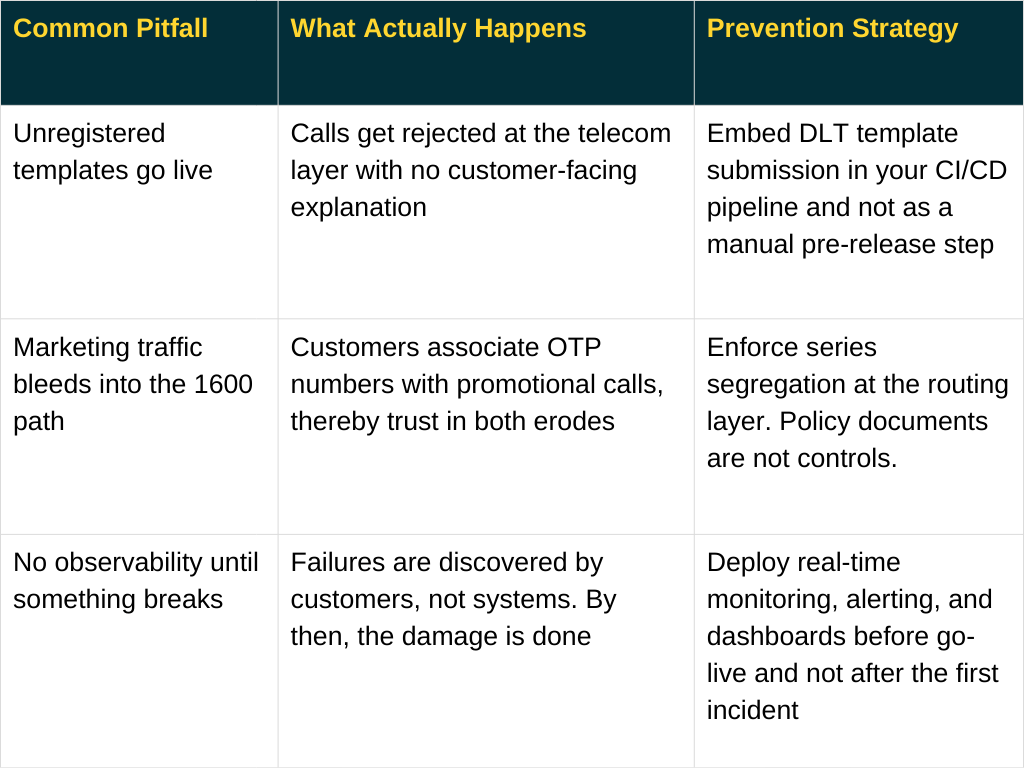
The failure patterns in 1600 series implementations are remarkably consistent. Here are the ones that cause the most damage and how to avoid them:
8. Your Action List for This Quarter
TRAI enforcement on transactional voice is tightening. Customer expectations around verified, trustworthy communications are rising. The institutions that have their 1600 series infrastructure properly architected won't just be compliant but they'll be ahead.
Start here:
- Audit all existing transactional voice triggers. Identify every unregistered template and every unregulated call path immediately
- Verify your telecom provider supports automated DLT workflows. Manual template management will not scale and will become a compliance liability
- Enforce routing segregation between marketing and transactional calls at the system level. A policy document is not a technical control
- Deploy observability and real-time alerting before your next production release
Conclusion: Not a Configuration Task - Its a Trust Infrastructure Decision
The 1600 series is not a telecom configuration detail that IT teams handle and move on from. When implemented with the right architecture, security posture, and operational discipline, it becomes the verified identity layer for every outbound voice interaction your institution has with customers.
That matters more than most IT leaders initially recognise. Customers who receive verified, reliable, context-relevant communications trust the institution behind them. Regulators who find clean DLT records and complete audit trails raise fewer findings. And IT teams with well-governed, observable systems spend less time responding to incidents & more time building.
In BFSI, trust isn't a soft metric - it's the product. Getting outbound voice right is no longer a roadmap item. It's a present strategic imperative. And the 1600 series is where that investment begins.