A few years ago, during a product-support interaction with an enterprise customer, something unexpected happened.
We had exchanged nearly a dozen emails. Two voice calls followed. Still, the issue wasn’t resolved. The customer sounded increasingly frustrated - not because the solution was complex, but because it was invisible.
The moment we switched to video, everything changed.
Within minutes, the customer showed the interface problem on screen, we clarified the misunderstanding, and the issue was resolved. What had taken two days collapsed into a single conversation.
That experience captures something important:
Video doesn’t just improve communication - it restores context.
And in customer experience, context is everything.
Across industries today, organizations are adopting video-enabled contact centers because they shorten resolution cycles, strengthen trust, and improve conversion outcomes in ways traditional channels cannot.
Customers No Longer Want Just Answers. They Want Understanding.
Modern customers expect interactions that feel:
- Immediate
- Personal
- Efficient
- Human
Voice explains.
Email documents.
Chat accelerates.
But video connects.
Industry CX benchmarks consistently show that organizations introducing visual-support workflows report 20 to 30% faster issue resolution in complex service scenarios where explanation alone is insufficient. This is particularly visible in onboarding, technical troubleshooting, and advisory conversations.
The shift toward video isn’t experimental anymore, it’s operational.
1. Trust Forms Faster When Conversations Become Visible
In traditional support environments, customers interpret tone but not intent.
Video changes that dynamic instantly.
Facial expressions, posture, and visual responsiveness create reassurance that cannot be replicated through voice alone. In advisory-driven industries like banking, insurance, and healthcare support, this visual reassurance significantly improves engagement quality.
In practical deployments, teams often notice that customers become more cooperative once interaction shifts from explanation to demonstration.
Trust accelerates decisions.
2. Complex Sales Conversations Become Simpler and Shorter
One pattern repeatedly appears in organizations that introduce video engagement into pre-sales workflows: fewer follow-up calls.
Instead of describing a solution architecture verbally, teams can walk customers through workflows live. Instead of sending documents, they show outcomes.
We’ve all experienced moments when a quick sketch on a whiteboard makes something instantly clear something that pages of email never quite manage to do.
Visual interaction reduces ambiguity.
Enterprise CX transformation studies frequently report shorter decision cycles in visually assisted product consultations, particularly in solution-heavy categories such as SaaS platforms, telecom services, and financial onboarding.
Seeing removes hesitation.
3. Troubleshooting Becomes Collaborative Instead of Sequential
Traditional support depends on sequential clarification:
“Can you describe what you’re seeing?”
“Which screen are you on?”
“What message appears?”
Video removes this friction.
Customers show the issue instead of translating it. Agents diagnose instead of guessing.
Organizations deploying visual-support capabilities in technical environments often report first-contact resolution improvements between 15% and 25%, especially when assisting with configuration or activation workflows.
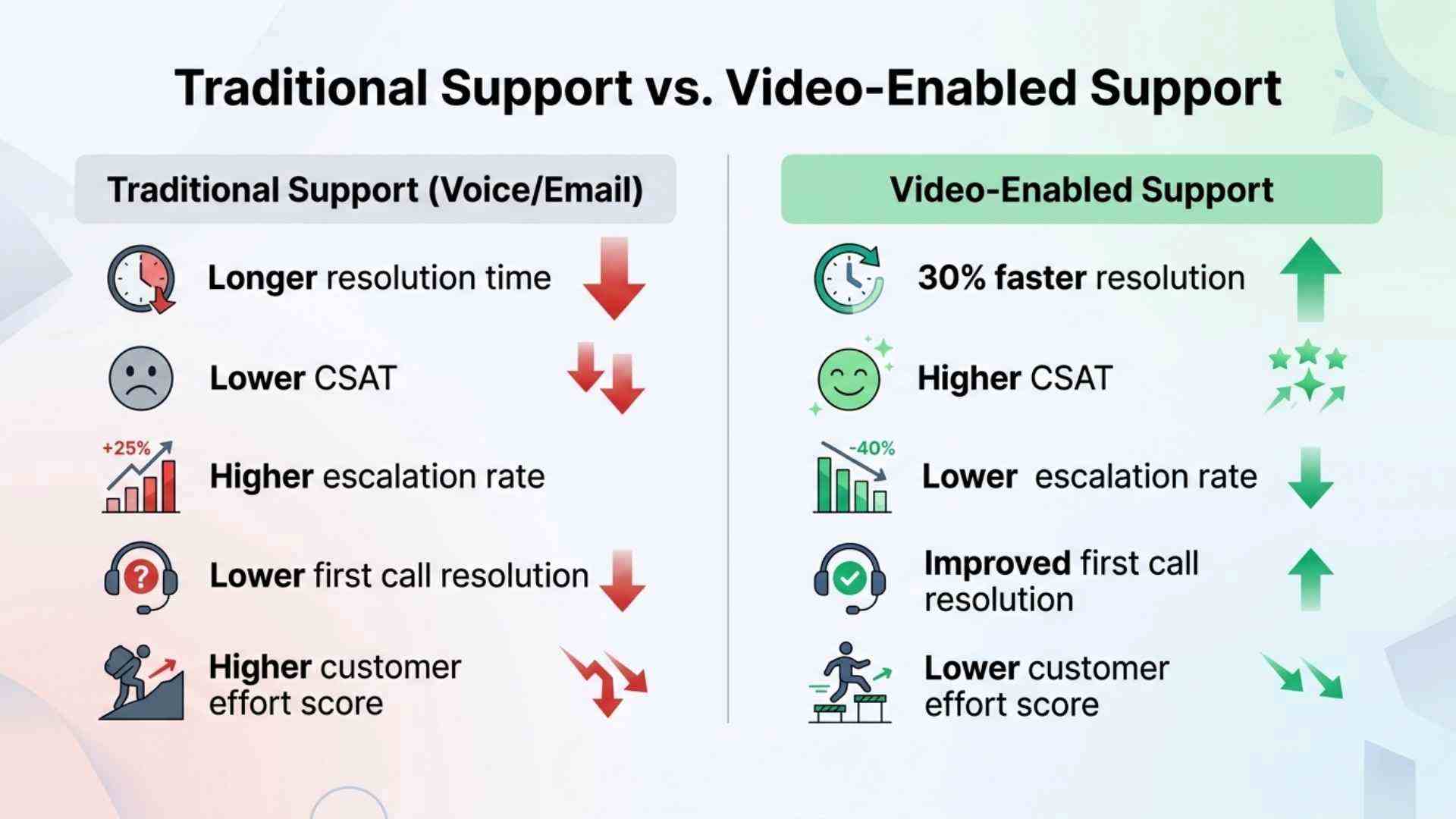
Resolution speed improves because interpretation disappears.
4. Customer Experience Improves When Interactions Feel Human Again
Customers rarely evaluate support quality only by speed.
They evaluate how the interaction felt.
Video restores something digital support channels gradually lost: presence. When customers feel seen and understood, they stay longer, cooperate more easily, and return more often.
This emotional continuity plays a measurable role in retention across relationship-driven sectors like financial services and education counseling.
5. Demonstration Replaces Explanation and That Changes Everything
There is a limit to what words can clarify.
Organizations introducing video-enabled advisory support consistently observe that customers adopt products faster when they see workflows performed live rather than explained step-by-step.
Visual walkthroughs reduce:
- Onboarding friction
- Configuration errors
- Misunderstanding-driven support tickets
This creates measurable downstream efficiency gains across service teams.
6. Operational Costs Decline in Unexpected Places
Many leaders initially assume video support increases infrastructure complexity. In practice, the opposite often happens.
When customers resolve issues visually:
- Repeat calls decline
- Field visits reduce
- Escalation cycles shorten
- Onboarding errors drop
Across distributed support environments, visual troubleshooting has been shown to reduce unnecessary technician dispatches in service-heavy industries such as telecom and device support ecosystems.
Efficiency improves quietly and consistently.
7. Relationships Strengthen Because Conversations Become Personal Again
Long-term customer value rarely comes from a single successful interaction. It comes from accumulated confidence.
Video introduces familiarity into digital engagement.
Customers remember faces more easily than ticket numbers. They recall conversations more clearly than instructions. They develop continuity with advisors instead of interacting with anonymous systems.
Over time, this creates loyalty that transactional channels cannot replicate.
8. Internal Teams Solve Problems Faster When Expertise Becomes Visible
Video engagement doesn’t only improve customer-facing workflows. It changes internal collaboration patterns as well.
Agents can:
- Consult supervisors during live interactions
- Bring specialists into conversations instantly
- Demonstrate workflows during training sessions
- Align decisions faster across distributed teams
Organizations operating multi-location service centers often observe noticeable reductions in escalation turnaround time once visual collaboration becomes standard practice.
Knowledge moves faster when people can see what others see.
9. Remote Service Delivery Becomes a Strategic Advantage, Not a Compromise
Hybrid operations are now permanent.
Customers expect support regardless of geography. Teams expect flexibility regardless of location.
Video-enabled contact centers allow organizations to support:
- Remote advisory interactions
- Global onboarding workflows
- Distributed agent environments
- Specialist consultations without travel
Instead of treating distance as a limitation, organizations begin treating it as infrastructure flexibility.
10. Business Performance Improves Because Communication Stops Being Fragmented
Ultimately, the strongest argument for video engagement is not emotional. It is operational.
Organizations introducing visual customer interaction capabilities commonly report improvements across multiple performance indicators, including:
- Higher engagement depth during advisory conversations
- Improved first-contact resolution
- Shorter onboarding cycles
- Increased conversion confidence
- Stronger retention continuity
These gains don’t appear because video replaces existing channels.
They appear because the video completes them.
Where Video Contact Centers Are Creating the Most Immediate Impact
Adoption is accelerating fastest in environments where explanation alone is insufficient:
- Financial consultations requiring document walkthroughs
- Insurance advisory interactions
- Telecom device troubleshooting
- Healthcare support coordination
- Education counseling workflows
- Field technician support
- KYC calls
In each of these scenarios, visual clarity directly influences customer confidence.
The Shift Toward Visual Customer Engagement Has Already Begun
Customers rarely ask for “video support” explicitly.
What they ask for is clarity. Speed. Confidence. Reassurance.
Video delivers all four simultaneously.
Organizations that recognize this early are not simply upgrading communication channels. They are redesigning how customers experience service itself.
And in a competitive service economy, that difference compounds faster than most teams expect.
With C-Zentrix Video contact center solution, your agents can initiate video calls or the customer can initiate video calls from web or mobile apps. The regular chat messaging can also double up as a video call on demand. So it provides all the flexibility to customers and sales/support team to have the much needed engagement.